A quick composition tip today. It's quite an easy technique and can produce a lot of "wall worthy" photos from your travels (or your hometown for that matter).
From Australia: a great ad for the Lumix G2
It's meant to advertise the "intelligent auto" settings of the camera, but it reminds me that the basics of composition are more important than knowing about specific settings.
That's why I don't make a single mention of aperture or shutter speed in book one. You've got to build that foundation of knowledge, arranging the elements in the frame, keeping it simple, waiting for the right moment, choosing the best photo. That's why Book One - The Foundation works with any camera.
Get that under your belt and then learn about f2.8 @ ISO500 +1.5EV to push your photos to the next level.
*UPDATE*
In response to Macrobe's excellent book recommendation I thought I'd post that book and two other great photographic resources that are worth spending some time with.
Flipping through the Amazon preview of The Photograph I saw those famous early images from Stieglitz and Steichen, Muybridge and Marey and was reminded of Jeff Curto's History of Photography podcast. Jeff is a professor of photography at a college in the Chicago area, and for the last several years he's been recording his class-sessions, and along with the presentation slides, uploading them as free podcasts.
So in other words, free college-level course to listen to whenever you damn well please!
He teaches in a really entertaining, down-to-earth, approachable way and it's a hell of a lot of fun to listen to. Highly recommended! http://photohistory.jeffcurto.com/
It's not apparent at first glance, but these two "Hassle Free Zone" signs in the photo below are actually two-hundred-twenty-two kilometers apart.
I also noticed the remarkable flexibility of the Mexican kilometer on my way to Chichen Itza, where the highway signage indicated that I was actually getting further from my destination as I headed straight for it.
The signs read: VIADOLLID 60km. Ten minutes later: VIADOLLID 60km. (still). Another ten minutes of highway and a third sign read: VIADOLLID 72km. The apparent wrinkle in time settled back to normal after that and I arrived in the city in about an hour. No hay problema! You'll get there when you get there!
I was listening to episode #653 of the excellent Lenswork podcast that brought up a very important point about the quantity of images needed to find the "one" image that says it all.
In Motojournalism Book One - The Edit chapter says to take many and show few. But how many?
It depends on the situation. There's no magic number, any situation with fast action will require more exposures than a landscape would. The idea is to give yourself plenty of options to choose from, so when you get down to the edit you can narrow your photos to the one imagethat captures what you saw, and how you felt when you saw it. It took five shots in a couple minutes to get one good image of this gravestone in El Salvador.
Here are two more examples of photographic situations that I've been in.
30 photos in ten minutes
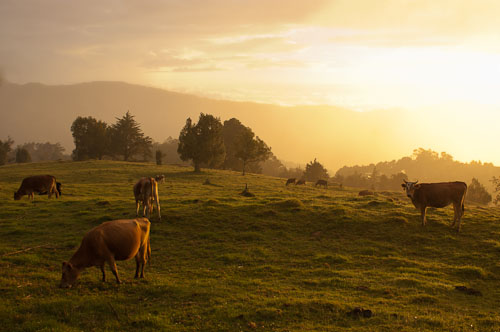
Sunset in the cloud forest of Costa Rica. I had to rush to find a place to sleep for the night, but I knew I'd be kicking myself If I passed-up such a great scene.
The light was changing fast and there were a lot of things to try:
I walked around 'till the silhouettes of the trees framed the image.
Some photos were shot vertically, some horizontally.
Some were shot directly into the sun, others off to one side.
Some featured the fence in the foreground without the cows, another featured only the cows.
Like Brooks Jensen says in the Lenswork podcast, I didn't know what image was going to work, and I didn't worry about it. I just knew I had plenty of material to work with once I got to the editing process.
This one image worked for me because it captured the glow of light, the haze in the air and the rich colours in the landscape. Just the way I felt it when I was there.
Two photos in as many seconds.
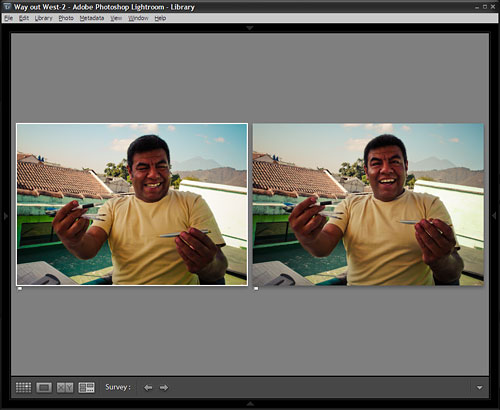
In Antuigua Guatemala I gave maestro Carlos - my Spanish teacher - a half-joke gift, he was using his Bic pens till the absolute last drop of ink, so I bought him a nice pen.
I had my compact camera at-the-ready, snapped two photos, and the moment was gone.
Technically the photos aren't wonderful - the light is not great and the horizon is plenty crooked - but the expression on Carlos' face nails the moment!
Make 'em count
One thing I think is important when shooting many photos, is to make a real effort in each shot you take. Carefully consider what's in the frame and how you are shooting it rather than blasting away wildly. Make each shot count!
Big thanks to the crew over at Traction magazine for giving Motojournalism book 2 a review!
Check out the rest of the issue below (click for fullscreen) , there's some great stuff in there. Traction is quite possibly the most irreverent motorcycle magazine out there. It's a hoot!
Ben Slavin of MotorcycleMexico.com caught-up with me for an interview a while back.
Ben's been all the way to the southern tip of Argentina on his ol' KLR and he's back on the road again in Mexico right now!
I've got to get a helmet-cam for the next big ride...
He's got some great videos that bring back the memories of the trip, go check em out on MotorcycleMexico.com!
I mentioned in Motojournalism Book Two that having quick access to your camera gear is key. You're gonna miss a ton of great photos if it's a hassle to get your camera out.
Gus from Florida sent me a few shots of his tankbag setup. He's found a great way of keeping things safe and organized using the padded dividers of an old camera bag:
"I bought a wolfman tank bag, gutted one of my lowepro camera bags and used it's dividers to turn the wolfman bag into a motorcycle-camera-bag. The bottom is padded the same as a typical camera bag is, so all I needed was the padded dividers. It worked great during our last trip where we rode from Miami to West Virginia."
Looks like it works great! One more thing you can do is attach the shoulder strap from the camera bag onto the D rings of the tankbag to make it easier to carry when you're walking around.
Here's a shot of my setup on the road: Same Wolfman Explorer bag, works perfectly on the KLR650.
I keep a sweater or scarf underneath the camera and lenses. I have the Nikkor 28mm 2.8 on the Nikon body, and the 85mm 1.8 Nikkor and 11-16 2.8 Tokina are kept in the LowePro slip-lock cases.
Motorcycle Travel Photography.
Motojournalism book one is about taking better photos of your adventures with the camera you have now. Written from a motorcycle travel perspective, but applicable to all overlanders, Book One teaches the foundational photographic techniques you'll need to come home with great photos of your travels.
Book One 41 pages - Just $10!
Motojournalism book Two is about how to choose camera equipment for your overland travel, how to pack it, and how to operate it. Manual mode, aperture, shutter-speed, ISO, exposure compensation, histogram, and heaps more.
Book Two 49 pages $15.
Read about the trip
Read about the last trip - Montreal to Panama - with plenty of words and photos.