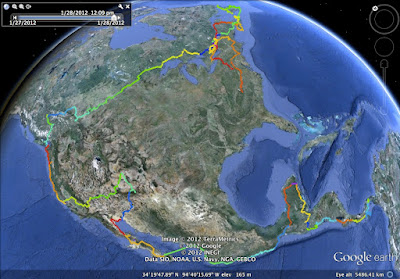
Travel maps - GPS tracks in Google Earth


Any overland traveller worth their salt loves a map. The excitement of a fresh paper map spread out on the floor, every mountain pass and izthmus, terra incognita promising adventure.
It's just as rewarding to revisit torn and battered maps on your return. The map looks different now, the terrain, roads and towns infused with memory of struggles and good times.

I feel the same way about electronic maps. Less romantic, surely. But everything has it's place and the flexibility of GPS software and Google Earth can really be an asset for sharing your adventure.

I'm not the type of traveller who enjoys pre-planning my route, road by road. I prefer spontaneity and flexibility, so I generally use my Garmin GPSmap 60CSx as a way of leaving "breadcrumbs, keeping the tracks as a record of where I've been.


Shit Bikers Say

That Chicken Bus came out of nowhere on my way to fly over the Darien, so I had to drag a bag on that apex... Say, are those Pelican cases?

Bill Dwyer of AtlasRider.com and Matthew Scott Johnston of Magic Rabbit Productions absolutely nail it. Whether you're a cruiser, a sport rider or an ADV rider this really is, Shit Bikers Say


Keep the dirty side up!

Motorcycle Documentary Filming

Another quick update! I've been running around Ontario filming the missing pieces of the motorcycle documentary. 
My producer, Dallas Shannon of Traction E-Rag has been pulling strings and calling-in favours to arrange the specific scenes that needed to be shot. Everybody from the vintage collectors to the motorcycle dealerships have been super accommodating scrambling to get the old and new motorcycles we need.
We've also shot three short interviews of people who know the two main characters of the documentary.

All for now, off to shoot the final scenes!


Sneak peek at the motorcycle documentary

Riding season is winding down - it's gorgeous now but won't be long before the last leaf has fallen and the deep freeze begins. I'll get in as many rides as I can before I have to dig out the battery tender and fogging oil.


Working on the documentary has been fascinating. There are so many elements that come together to make it work. I've been working out the documentary with my producer and we've found that the audio beats the video in importance. We're putting together the story like a radio show - the spoken word is the the structure, the frame, and the video will be placed on top of that frame.

We found that the old fashioned method of shuffling around index cards on a table helped us best in working out the plot. Each index card was a bit of dialogue that our subjects talked about and having them spread out before us really made a logical flow of ideas visible.


Documentary seems to be similar to travel photography; you go out having a rough idea of what you will find, but you really don't know what the story will be until you come back and see what you've shot.

In the meantime, I'm getting deep into learning video editing. I'm taking what I've learned about processing my photos and applying that knowledge to the similar tools in the video editor.
It's all the same things, a bit of contrast, adjusting the white-balance and saturation, a subtle vignette.

Here's a short video made with a bit of the extra footage we shot - just made to teach myself the tools, and give a hint of what's coming. I had fun recording the miniature soundtrack too.
It's all pretty pictures with no story - just the sort of video I was lambasting in the last post!


All for now, I'm off to ride to Ontario for the weekend, see you on the road!


Motorcycle documentary video shoot

Wow, just back from an intense week of motorcycle video shooting in Ontario. I'm creating a short documentary with Dallas Shannon of Traction E-Rag about couple of motorcycle riders we know.
It was go-go-go all week! Up at dawn and out in the woods to shoot.

We got fantastic interviews, plenty of surprises and great stories from both of the riders.
I still can't give away the plot, but I've got a few screen-grabs to show.


I used the Nikon D7000 as the main camera - despite the camera being horribly awkward to shoot video with - the image quality and lens choice was so good I was willing to put up with the difficulties.

The Panasonic DVX100A is a fantastic old camera, but the standard-definition images just couldn't hang with the hi-def Images from the Nikon. So it was pressed into service as an audio recorder with a Seinheisser MD421 studio mic plugged in to the XLR inputs. Nice to be able to let the tapes roll with an assistant (thanks KG!) doing the sound while I concentrated on capturing great images with the Nikon.

Lots of folks generously loaned gear for us to shoot with. It was a real patchwork gear setup with all the "wrong" kit for the job - but I'm thrilled about all the great stories and images we came back with. I think we've really made something out of nothing

(most of the kit - minus GoPro and D7000 - Click to enlarge) 

 Me and the mobile studio:


Screen captures from the raw footage:


The bulk of the work starts now, as we look for the real story, and chip ten hours of footage down to ten minutes or less...

Rene Cormier Presentation and motorcycle video production

Plenty going on lately, time for an update!

On the road and through the cornfields to Ontario...
P1330614.jpg

A few weeks back, I went to a great presentation by Rene Cromier at BMW Moto Internationale in Montreal.

Rene took a five-year, 41-country, 154 000km (95 000 mile) trip, all the way around the world. The amazing stories are endless and he had much practical advice for everybody considering a similar voyage.

What I admire most is how he's taken his experience and turned it into a career that works for him.
Between book tours and leading adventure motorcycle trips in Africa he's able to live life on his own terms.

His book The University of Gravel Roads is a great read, with plenty of photos and thoughts on the way we and others live. It certainly deserves a spot on your motorcycle bookshelf among Jupiter's Travels and Lois on the Loose.

Rene, holding his breath in the South-Atlantic
DSC_0192.jpg

The front fender of Rene's BMW F650. It was decorated in Pakistan, with layers of reflective vinyl material, cut freehand with a razor.
DSC_0198.jpg

My next project is a collaboration with a colleague of mine, we'll be shooting a short documentary video in September. I can't give away the plot, but it will revolve around a couple of particularly well-heeled motorcycle riders we know.

I've been absolutely devouring information about shooting and editing video. It's learning from the ground up about video formats and frame rates and codecs, and all that nonsense, but really it's just taking the audio production I already know and combining it with my photo editing skills. I know exactly what I want to do, I just have to learn how the cameras and software do it!

It's a real soup-from-a-stone production - we're borrowing nearly all the equipment required.
We've got an old Panasonic DVX100A video camera for action shots and audio recording, an Sennheiser md421 microphone to record interviews, A brand new Nikon D7000 to shoot gorgeous HD video, and as many GoPro helmet cameras as we can get our hands on. And it will all be put together with an obsolete copy of Final Cut Pro on a G5 Mac that I got for free from an office.
I sure do enjoy the challenge of making something from nothing, but money for food, gas and video tape will have to come from somewhere...

Panasonic DVX100A - Great camera, but only shoots in standard definition
There's a lot of the same skills used in photography and video, but the big difference seems to be that video needs a story, or a change, or something to move it along.

A photograph can stand on it's own as an interesting image. Photography is pure image-making - the composition of, shape, line, texture, colour.


You could make a compelling photo of a motorcycle tire, but a video of a motorcycle tire?
There's so much more you'd need to add to make it worth watching.


Ontario enduro rides

Lately, we've seen so much beautiful footage with SLR cameras that shoot video. The images are gorgeous, but often the videos are devoid of story.
After the ohh, ahhh, has worn off there's nothing there. An empty shell.


The short documentary we're working on is going to be very much character driven. The subjects are lively and interesting people. There's already a thousand stories there, the challenge will be choosing what to focus on. It will be a compelling story first and visually interesting on top of that story.

Here's a clip of the footage we shot to test the equipment. Still some technical kinks to be ironed-out but it was enough to convince us that we can do a great job on the real shoot.


I'll keep you all posted on the progress!

Baja Revisited - Post processing for a vintage look

Pay no attention to that man behind the curtain...


One of the amazing aspects of modern photography is the range of creative possibilities that digital post processing offers. We have the entire history of photography to pull inspiration from. Daguerreotype to Polaroid, Kodachrome to HDR.

With this series of photos from Baja Mexico, I'm drawing on old album covers, dusty basement collections of National Geographic, antique shop photographs, 1980's Robby Müller movies. A haze of nostalgia to mask the cinical clarity of an unprocessed digital image.


Motojournalism-1270646

The first experiment was to restrict myself to a square 1:1 crop ratio. The photos were not taken with a square crop in mind, so it took a bit of work to find photos that worked well with this ratio.

I use Lightroom 3  to process all my images, and here I used a mix of the basic exposure tools, the tone curve, split toning, and the effects panel to achieve the vintage look.

I used quite a bit of fill light and much less contrast than usual to give a faded appearance, and adjusted the colour temperature towards yellow for a warm tone.
The tone curve was used to gently bring back a bit of the lost contrast, and the split toning was used to bring a coloured tone to the shadows - another characteristic copied from the imperfection of vintage photos.

Motojournalism-1270475

Motojournalism-3809


The surprisingly good film grain filter built-in to Lightroom takes the edge off the digital clarity and adds to the old look at stronger settings. 


After the photos were exported from Lightroom, I used Photoshop to apply a black frame from the Flickr Noise and dust through the viewfinder pool with a multiply layer.

I recommend John Arnold's excellent Photo Walkthrough website for tutorials on the finer details of Lightroom and Photoshop.

You can find the full gallery with larger images here

Motojournalism-1270186

Motojournalism-1270363

Motojournalism-3611

Motojournalism-1270302

Motojournalism-1270346